No, I am not saying you should stop using GenAI video models. They are totally fine for generating video assets, but terrible at making a complete, finalized motion design composition with consistent content, realistic-looking animations, high-quality typography, effects that make sense, and more. You will also save a lot of time and money by not doing it.
"Yeah, but we can control them much better today using ComfyUI and similar tools."
To that, my answer is yes: you can get better creative control with node-based editors. However, they are time-consuming to build, and they scale poorly. You pay per second across multiple models at once, or you need heavy GPU hardware to run them locally. If you have unlimited time and budget, sure, go for it.
Let me tell you a secret. Well, in fact, it isn't a secret anymore: LLMs (like GPT Astra and other spatially aware models) are getting remarkably good at understanding 2D/3D space and structural scene data. In other words, there is a high chance that the LLM of your choice can construct a complete motion design scene - with images, text, animations, and timing, that actually meets commercial standards. Many creative studios today are already hooking LLM agents up to Adobe After Effects to automate motion content. Such a "creative agent" orchestrates the entire workflow: it builds the animations, calls a third-party image or video model to generate assets on the fly, and composites everything into a final sequence.
However, the major pain point is still guiding the agent so the output actually matches your storyboard or visual reference. The solution is what we call a "creative feedback loop" - letting the LLM inspect its own intermediate results and refine them. It works like this: the agent generates scene data (say, an AE composition), renders it, samples a few frames, and compares them against your reference or creative feedback. If the result hits the mark, it stops. If not, the agent adjusts and runs another iteration until it nails the look.
The problem? Running feedback loops on After Effects is painfully slow on non-trivial content. Even if you configure the agent to sample just a couple of frames per pass, AE still has to spin up and render the project, which creates a massive bottleneck. And what if your pipeline is completely programmatic, running in the cloud and processing data in real time? Running After Effects in the cloud is still slow, and expensive.
This is where the Blitframe API comes in.
Blitframe doesn't just support rendering AE-made motion graphics (you can check our docs for the full list of supported features), it does so many times faster than real time. In our latest benchmarks on the exact same test project, Blitframe renders 16.9x faster than After Effects on a standard Windows laptop, and over 28x faster in our production environment.
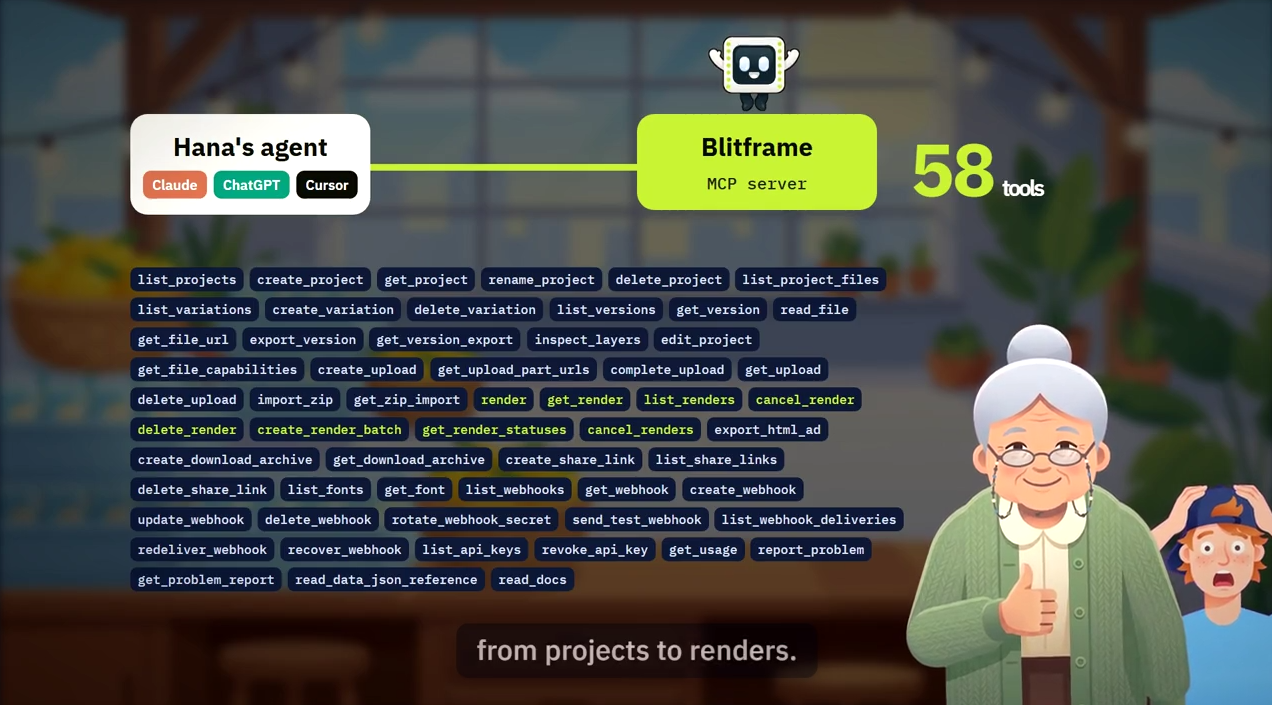
You can plug your LLM agent directly into Blitframe via our MCP server, making the feedback loop practically effortless. Because the renderer returns sampled frames in seconds, the agent can refine its output rapidly, turning what used to take hours or days into a finished, ready-to-distribute ad in minutes. Moreover, Lottie is Blitframe’s default data format: the agent simply generates a data.json file and passes it to the API as part of the motion project. Because LLMs were heavily trained on web data and JSON structures, they already understand Lottie natively, allowing them to describe scene elements, animations, and transforms with high accuracy.
And unlike the flat, baked-in pixels you get from a generative video model, an agent-authored data.json file also bridges directly back into a manual workflow. You can import that exact composition into Adobe After Effects using the Importer plugin available on our website and keep editing the entire graphics hierarchy—layers, keyframes, text, and effects. Think about how much heavy lifting that cuts out for a motion designer: the agent automates the bulk of the initial build and layout, while leaving the door wide open for hands-on, frame-accurate refinement inside a pro tool.
To put it simply: using LLMs to describe motion design, rather than forcing video models to generate final pixels, is quickly becoming the standard approach for professionals. It saves time and budget while delivering higher-quality, brand-consistent results. If you need both creative fidelity and velocity at scale, purely generative pipelines won't cut it. After Effects is too heavy for rapid agentic loops, and HTML-based rendering APIs are too limited for the visual complexity professionals require.
Blitframe was built to close that gap.
Want to test it on your own content? Check out the Quickstart, or sign up for a 14-day free trial (no credit card required) and let your agent take Blitframe for a spin.